What Does Tax Domicile Mean? A 2026 Guide for Expats
Tax domicile is defined as your fixed, permanent home for legal and tax purposes, and it determines where you owe long-term tax obligations. Most people confuse it with tax residency, but the two concepts carry distinct legal weight in countries like the UK, Australia, Ireland, and the United States. Understanding tax domicile rules before you move abroad or restructure your finances can save you from unexpected tax bills, treaty disputes, and compliance failures. This guide explains how tax domicile works, how it differs from residency, and what it means for your personal tax planning in 2026.
What does tax domicile mean vs. tax residency?
Tax domicile and tax residency are related but legally separate concepts. Tax residency is typically determined by how many days you spend in a country within a tax year. Tax domicile goes deeper. It refers to the country you treat as your permanent, long-term home, regardless of where you currently live.
Overhead table with papers comparing tax domicile and residency
Domicile and residence can coexist for tax purposes, requiring careful legal mapping per jurisdiction for accurate tax treatment and treaty claims. That overlap is exactly what trips up expats and international workers.
Here is how the two concepts differ in practice:
- Tax residency is usually time-based. Spend enough days in a country and you become a tax resident there.
- Tax domicile is intent-based. It reflects where you intend to settle permanently, even if you currently live elsewhere.
- You can be resident but not domiciled. A British citizen living in Spain for two years may still be UK-domiciled if they plan to return.
- You can be domiciled but not resident. An Australian citizen living abroad may still hold Australian domicile under the Australian Taxation Office's domicile test.
- Domicile affects different taxes. In the UK, domicile status affects inheritance tax and certain income tax rules, not just residency-based taxes.
Pro Tip: If you are planning an international move, get a written legal opinion on both your residency status and your domicile status before you file your first tax return in the new country. Fixing a misclassification after the fact is far more expensive than getting it right upfront.
Tax domicile and tax residence are often confused, but from an Irish tax perspective they have distinct meanings and implications, particularly for tax liabilities. Ireland treats domicile as a legal concept with no statutory definition, which makes professional guidance especially critical there.
What are the three types of domicile in law?
Tax law recognizes three distinct categories of domicile. Each one has different rules for how it is acquired and how it can be changed.
-
Domicile of origin. This is the domicile you receive at birth, typically from your father under common law systems. You do not choose it, and it never fully disappears. Even if you acquire a new domicile later, your domicile of origin can revive if you abandon your new domicile without replacing it.
-
Domicile of dependence. This applies to children and, historically, to married women under older legal systems. A child's domicile follows that of the parent they depend on. When a child reaches legal adulthood, their domicile of dependence converts into a domicile of origin for legal purposes.
-
Domicile of choice. This is the domicile you acquire by moving to a new country with the clear intention of settling there permanently. Changing domicile requires clear intent and factual residence. Some countries allow only one domicile at a time. That single-domicile rule matters enormously for tax planning, because it means your obligations in your old country do not end until your new domicile is legally established.
The domicile of choice test is the most relevant for expats. Courts and tax authorities look at evidence like property ownership, where you keep your family, where you hold bank accounts, and whether you have taken steps to sever ties with your previous country. Intention alone is not enough. You need both physical presence and documented intent.
How is tax domicile determined in the US, UK, and Australia?
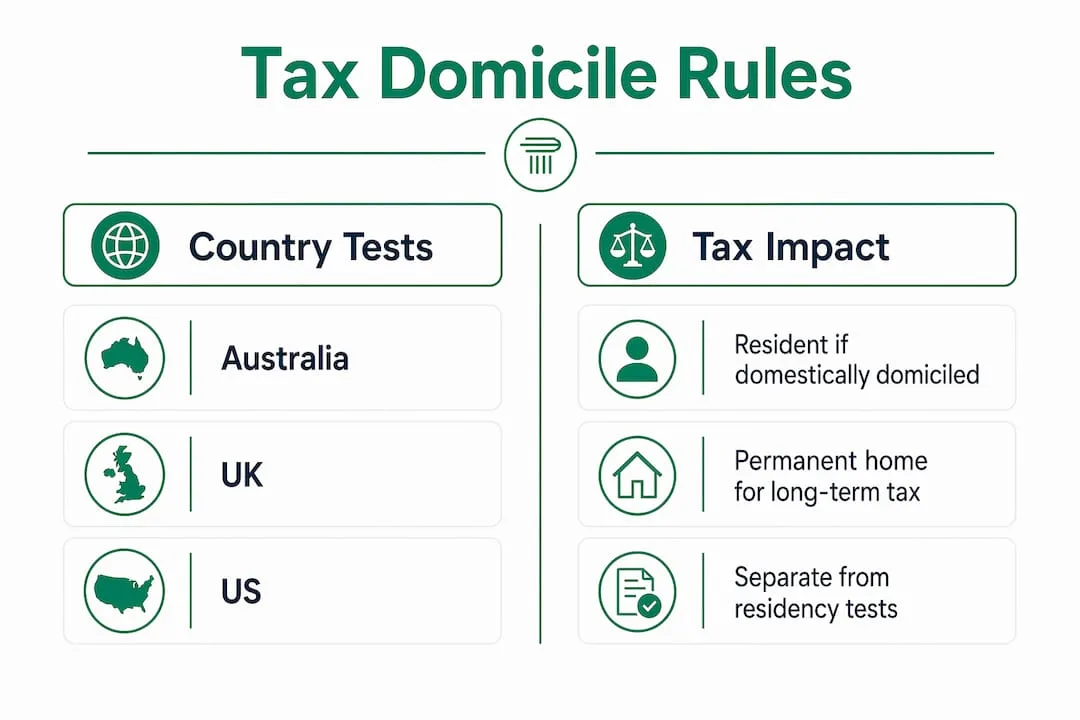
Different countries apply domicile tests in very different ways. The table below summarizes the key rules across three major jurisdictions.
Infographic comparing tax domicile rules by country
| Country | Domicile test | Key tax impact |
|---|
| Australia | Domicile test: resident if domicile is in Australia, unless permanent place of abode is abroad | Determines tax residency for worldwide income |
| United Kingdom | Long-term permanent home concept; three types recognized | Affects income tax, capital gains tax, and inheritance tax |
| United States | Domicile is a state-level concept; federal residency uses green card and substantial presence tests | State income tax and estate tax obligations |
Australia's domicile test
The Australian Taxation Office states that you are a tax resident if your domicile is in Australia, unless your permanent place of abode is outside Australia. That second condition is critical. An Australian citizen living in Germany for three years with a permanent lease and no Australian home may successfully argue their permanent place of abode is abroad. The ATO's domicile test highlights that domicile alone does not determine residency. The permanent place of abode must be considered alongside it.
The UK's domicile rules
The UK distinguishes domicile from tax residence, treating domicile as your long-term permanent home that can change over time. UK domicile status affects income tax on foreign income, capital gains tax, and inheritance tax on worldwide assets. A non-UK domiciled individual living in the UK may qualify for the remittance basis of taxation on foreign income, which is a significant financial advantage.
The US approach
The IRS determines tax residency through the green card or substantial presence tests, while domicile remains a distinct legal concept handled at the state level. A person can be both resident and nonresident in the same federal tax year under IRS rules. State domicile rules vary widely. California, for example, aggressively pursues former residents who claim to have changed their domicile but maintain California ties.
Treaty tie-breaker rules
When you hold dual residency or dual domicile status, double tax treaties use tie-breaker rules that prioritize permanent home, center of vital interests, and habitual abode. These rules reduce double taxation, but they require careful documentation to apply correctly.
Pro Tip: Documentation of your permanent home availability, including legal ownership, lease agreements, and continuous access records, is vital in treaty scenarios when declaring domicile. Keep a paper trail from day one.
What are the practical advantages of understanding your tax domicile?
Knowing your domicile status gives you control over your tax position. Ignoring it leaves you exposed to unexpected liabilities in multiple countries at once.
- Income tax planning. Your domicile determines whether you pay tax on worldwide income or only on income sourced within a country. In Paraguay's territorial tax system, for example, foreign-source income is generally taxed at 0%, making domicile and residency planning especially valuable for remote workers.
- Capital gains tax. Some countries only tax capital gains for domiciled residents. Changing your domicile before a major asset sale can legally reduce your tax exposure.
- Inheritance and estate tax. The UK charges inheritance tax on worldwide assets for UK-domiciled individuals, even if they live abroad. Establishing a domicile of choice in another country before death can significantly reduce the estate tax burden.
- Treaty benefits. In domicile-based systems, you only have one domicile at a time even if you have multiple residences. That single-domicile rule determines which country's treaty benefits you can claim.
- Avoiding double taxation. Without a clear domicile position, two countries can simultaneously claim taxing rights over your income and assets. Treaty tie-breaker rules resolve this, but only if your domicile is clearly documented.
Need personalized help?
Get expert guidance for your Paraguay relocation journey. Our team is here to help you with residency, business setup, real estate, and banking solutions.
Common pitfalls include assuming that leaving a country automatically ends your domicile there, failing to document your intent to settle permanently in a new country, and underestimating how long it takes for a domicile of choice to be legally recognized. Tax authorities in the UK and Australia regularly challenge domicile claims that lack supporting evidence.
Key Takeaways
Tax domicile is your single, legally recognized permanent home that determines your long-term tax obligations across income, capital gains, and estate taxes in every jurisdiction where you have ties.
| Point | Details |
|---|
| Domicile vs. residency | Domicile is intent-based and permanent; residency is time-based and can change annually. |
| Three legal types | Domicile of origin, dependence, and choice each carry different rules for acquisition and change. |
| Jurisdiction differences | Australia, the UK, and the US each apply domicile tests differently, with distinct tax consequences. |
| Treaty tie-breakers | Dual domicile conflicts are resolved by treaty rules that prioritize permanent home and vital interests. |
| Documentation matters | Legal ownership, lease records, and continuous access evidence are required to defend a domicile claim. |
Why most people get their domicile wrong until it costs them
I have seen this play out more times than I can count. Someone moves abroad, spends a year or two in a new country, and assumes their tax ties to their home country have been cut. They have not. Domicile of origin is remarkably sticky. Courts and tax authorities treat it as the default position you return to unless you can prove, with hard evidence, that you have genuinely settled elsewhere.
The most common mistake I see is confusing physical absence with legal change of domicile. Spending three years in Paraguay, for example, does not automatically make you Paraguayan-domiciled. You need documented intent, a permanent home, and severed ties with your previous country. The burden of proof sits with you, not the tax authority.
The second mistake is treating domicile as a one-time decision. Tax laws around domicile are evolving. The UK has made significant changes to its non-domicile rules in recent years, and other jurisdictions are watching closely. What worked as a domicile planning strategy in 2020 may not hold up in 2026. Get jurisdiction-specific legal advice every time your circumstances change, not just when you first move.
The good news is that when you get domicile right, the advantages are real and lasting. A properly established domicile of choice in a low-tax or territorial-tax jurisdiction can legally reduce your global tax burden for decades.
— Alejandro
How Movetoparaguay helps you plan your tax domicile and residency
Establishing a new domicile is not a paperwork exercise. It requires a clear legal strategy, jurisdiction-specific knowledge, and ongoing compliance support.
Movetoparaguay specializes in helping U.S. expats and remote workers establish tax residency in Paraguay, a country with a territorial tax system that generally applies 0% tax on foreign-source income. The team reviews your individual case in detail, covers the formation of Paraguayan companies, and provides ongoing tax compliance support with full transparency on fees and timelines. If you want a structured, professional path to changing your domicile and residency status, a tailored consultation with Movetoparaguay gives you specific next steps based on your exact circumstances.
FAQ
What does tax domicile mean in simple terms?
Tax domicile is the country you legally treat as your permanent home for tax purposes. It determines your long-term tax obligations, including income, capital gains, and inheritance taxes.
Is tax domicile the same as tax residency?
No. Tax residency is based on how many days you spend in a country. Tax domicile reflects your permanent, long-term home and carries different legal consequences, particularly for inheritance tax and treaty benefits.
Can you have more than one tax domicile at a time?
No. In domicile-based systems, you hold only one domicile at a time, even if you have multiple residences across different countries.
How do you change your tax domicile?
You change your domicile by moving to a new country with the clear, documented intention of settling there permanently. Both physical presence and evidence of intent are required. Intention alone is not sufficient.
Why does tax domicile matter for expats?
Tax domicile determines which country can tax your worldwide assets and income over the long term. For expats, establishing the right domicile in a low-tax jurisdiction can legally reduce global tax exposure for income, capital gains, and estate planning purposes.