RUC Registration in Paraguay: Your 2026 Tax ID Guide
The RUC, formally known as the Registro Único del Contribuyente, is Paraguay's unique tax identification number assigned to every individual and legal entity conducting economic activities in the country. If you are planning to live, work, or run a business in Paraguay, understanding what is RUC registration Paraguay requires is the first step toward full legal and tax compliance. The RUC is issued and regulated by the DNIT (Dirección Nacional de Ingresos Tributarios), Paraguay's national tax authority. Without it, you cannot legally issue invoices, file taxes, open a business bank account, or complete most formal transactions.
What is the format and structure of the Paraguayan RUC number?
The Paraguayan RUC number follows a specific format that tells you immediately whether the holder is an individual or a legal entity. RUC numbers for legal entities begin after 80,000,000 and consist of 8 digits plus a single check digit. Individuals, on the other hand, receive a RUC number that mirrors their national Cedula ID, which can be up to 9 digits, also followed by a check digit.
The final digit in every RUC number is a checksum. It is calculated using a specific mathematical formula applied to the preceding digits. This checksum allows tax systems and invoicing platforms to validate a RUC number instantly without querying a central database.
Hands holding Paraguayan RUC document close-up
| Taxpayer Type | RUC Format | Example |
|---|
| Individual (natural person) | Up to 9 digits + check digit | 1234567-8 |
| Legal entity (company) | 8 digits starting above 80,000,000 + check digit | 80123456-7 |
| Foreign individual | Cedula extranjera number + check digit | 987654321-0 |
The format distinction matters in practice. When you receive an invoice or sign a contract, the RUC number on the document tells you whether you are dealing with a registered company or a private individual. This is especially relevant for B2B transactions under Paraguay's SIFEN electronic invoicing system.
Pro Tip: Always verify a counterparty's RUC number through the DNIT's online portal before signing contracts or processing payments. An invalid check digit is a clear sign of a fraudulent or inactive registration.
Who must register for a RUC in Paraguay?
The DNIT requires every person or entity earning income or conducting business in Paraguay to obtain a RUC. This obligation is broad and applies to a wide range of taxpayers.
The following groups must register:
- Paraguayan citizens engaged in any taxable economic activity, including freelancers, sole traders, and professionals
- Foreign residents who hold a Paraguayan Cedula and conduct business or earn local income
- Legal entities, including corporations, limited liability companies, and branches of foreign companies
- Non-profit organizations that engage in economic activities, even if their purpose is charitable
- Importers and exporters, regardless of whether they are individuals or companies
- Property owners who rent or sell real estate and generate taxable income
The link between the Cedula and the RUC is direct for residents. Your Cedula number becomes the base of your RUC. This means you must obtain your Paraguayan national ID before you can register for a tax number. Foreigners who have completed the residency process and received their Cedula paraguaya follow the same path as citizens.
Non-registration carries real consequences. Without a valid RUC, you cannot issue legal invoices, complete property transactions, or open a corporate bank account. The DNIT can impose penalties, trigger tax audits, and block commercial activity for non-compliant individuals and businesses.
How to register for a RUC in Paraguay
The RUC registration process runs through the DNIT, Paraguay's tax authority. Most registrations happen in person at a DNIT office, though the agency has expanded online options for straightforward cases. The timeline ranges from same-day completion for in-person visits to a few business days for online submissions.
Required documents
Gather these documents before you visit a DNIT office:
- Cedula paraguaya (your Paraguayan national ID card). This is mandatory for all applicants.
- Proof of address in Paraguay, such as a utility bill or a notarized rental agreement.
- Formulario 600, the official DNIT registration form, which you can download from the DNIT website or collect at their offices.
- Company formation documents for legal entities, including the constitutive act (articles of incorporation), notarized and apostilled if the company was formed abroad.
- Power of attorney if a representative is registering on behalf of the taxpayer.
Step-by-step registration process
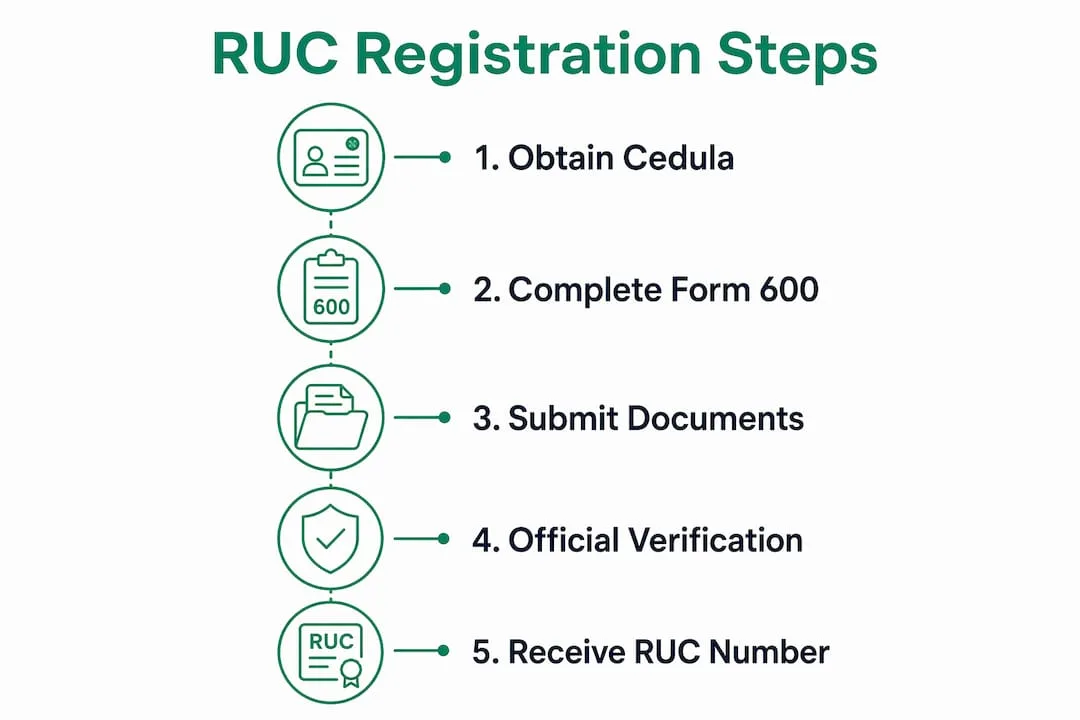
- Obtain your Cedula paraguaya through the residency process before attempting any RUC registration.
- Complete Formulario 600 accurately, declaring your primary economic activity using the correct DNIT activity code.
- Gather all supporting documents and make certified copies where required.
- Visit your nearest DNIT office and submit the application at the taxpayer services counter.
- Receive your RUC certificate, which confirms your tax identification number and registered economic activities.
- Activate your RUC for electronic invoicing through the SIFEN portal if your business requires it.
Pro Tip: Declaring the wrong economic activity code on Formulario 600 is the most common registration mistake. Each activity code ties to specific tax rates and filing frequencies. Consult a local tax advisor or Movetoparaguay before submitting to confirm you are using the correct classification.
What is the role of the RUC in Paraguayan tax compliance and invoicing?
Infographic showing step-by-step RUC registration process
The RUC is the foundation of Paraguay's entire tax compliance infrastructure. Every fiscal document issued under the SIFEN electronic invoicing system must include a valid RUC number. SIFEN is Paraguay's mandatory digital invoicing platform, and it connects directly to the DNIT's tax validation systems.
The RUC's role in SIFEN goes beyond a simple identifier. It functions as a digital business identity that links every transaction to a registered taxpayer. Here is how it integrates with tax and invoicing operations:
- XML fiscal documents embed the RUC of both the issuer and the recipient, creating a traceable transaction record for the DNIT
- Digital certificates required for SIFEN compliance are issued specifically to a RUC holder, meaning the certificate is tied to the tax identity, not just the company name
- B2B and B2C invoicing both require valid RUC numbers on every transaction, with no exceptions for small businesses above the minimum threshold
- Tax filing obligations are organized by RUC classification, determining whether you file monthly, quarterly, or annually
- ERP and accounting systems must store and validate RUC numbers for every supplier and customer to generate compliant fiscal documents
SIFEN compliance requires companies to hold qualified digital certificates tied directly to their RUC. This makes RUC management a technical requirement, not just an administrative one. Businesses that delay RUC registration also delay their ability to issue legal invoices and receive tax credits.
| Tax Function | RUC Requirement |
|---|
| Issuing electronic invoices (SIFEN) | Mandatory for issuer and recipient |
| Obtaining a digital certificate | Must be tied to a valid RUC |
| Filing monthly VAT returns | RUC classification determines filing schedule |
| Claiming tax credits | Valid RUC required on all input invoices |
| Registering for import/export | RUC required at customs declaration |
What are the practical implications of having a RUC?
A valid RUC opens access to the formal economy in Paraguay. It is not just a tax number. It is the credential that makes you a recognized legal and fiscal actor in the country.
The practical benefits and obligations include:
Need personalized help?
Get expert guidance for your Paraguay relocation journey. Our team is here to help you with residency, business setup, real estate, and banking solutions.
- Banking: Most Paraguayan banks require a RUC to open a business account or process commercial transactions above certain thresholds
- Contracts: Government and corporate contracts require a valid RUC from all parties, making it mandatory for any formal commercial relationship
- Property transactions: Buying or selling real estate in Paraguay requires both parties to present their RUC at the notary
- Tax residency proof: The RUC certificate serves as one of the key documents when demonstrating tax residency in Paraguay, which is relevant for expats using Paraguay's territorial tax system
- Import and export: Customs clearance requires a registered RUC, making it non-negotiable for any cross-border trade
- Monthly and annual filings: Once registered, your RUC classification determines your filing calendar. Failing to file on time generates automatic penalties
The connection between the RUC and residency is particularly relevant for U.S. expats and remote workers. Paraguay's territorial tax system generally applies 0% tax on foreign-source income. But to benefit from that structure legally, you need a valid Cedula, a registered RUC, and documented tax filings. The RUC is the link that makes your tax residency real in the eyes of the DNIT. You can find detailed guidance on the residency and tax process on the Movetoparaguay blog.
Key Takeaways
The RUC is Paraguay's mandatory tax identification number, and registering correctly from the start determines your ability to invoice, file taxes, and operate legally in the country.
| Point | Details |
|---|
| RUC definition | The Registro Único del Contribuyente is Paraguay's official tax ID for all taxpayers conducting economic activities. |
| Format by taxpayer type | Individuals use their Cedula number; legal entities receive an 8-digit number starting above 80,000,000. |
| Registration requirement | All residents, foreigners with a Cedula, and legal entities earning income in Paraguay must register with the DNIT. |
| SIFEN integration | The RUC is embedded in every electronic invoice and required for digital certificate issuance under SIFEN. |
| Practical necessity | Without a RUC, you cannot open a business bank account, issue invoices, complete property deals, or prove tax residency. |
My take on RUC registration after working with expats in Paraguay
The biggest mistake I see foreigners make is treating the RUC as a formality they will handle later. They arrive in Paraguay, get their Cedula, and then wait months before registering with the DNIT. By that point, they have already missed filing deadlines, cannot issue invoices to clients, and sometimes face penalties for economic activity conducted without a registered tax identity.
The second issue is the economic activity declaration on Formulario 600. Most people pick a general category without realizing that the activity code directly determines their tax rate, filing frequency, and eligibility for certain deductions. I have seen cases where a freelancer registered under the wrong category and spent years filing under an incorrect tax regime before a local accountant caught the error.
SIFEN has changed the stakes significantly. Paraguay's electronic invoicing system means the DNIT now has real-time visibility into every transaction. There is no grace period for non-compliance anymore. If your RUC is not active and properly classified, your invoices will not pass validation, and your clients will not be able to claim tax credits on purchases from you.
My recommendation is always the same: get your Cedula, then register your RUC within the first 30 days. Work with a local advisor who knows the DNIT's current requirements, because the process has evolved with SIFEN integration. Movetoparaguay reviews your individual case, confirms the right activity codes, and handles the documentation so you do not start your life in Paraguay with a compliance problem.
— Alejandro
How Movetoparaguay supports your RUC registration and tax compliance
Getting your RUC right from day one protects your business and your tax residency status in Paraguay. Movetoparaguay specializes in exactly this process for U.S. expats, remote workers, and entrepreneurs relocating to Paraguay.
Movetoparaguay offers tailored consultations that review your specific situation, confirm the correct economic activity classification, and guide you through every document the DNIT requires. Their services cover company formation, Cedula applications, RUC registration, and ongoing tax compliance, all with clear timelines and transparent fees. If you are ready to establish your tax identity in Paraguay the right way, start with a consultation to get specific next steps for your case.
FAQ
What does RUC stand for in Paraguay?
RUC stands for Registro Único del Contribuyente, which translates to Unique Taxpayer Registry. It is Paraguay's official tax identification number issued by the DNIT to all individuals and legal entities conducting economic activities in the country.
How do I get a RUC number in Paraguay?
You must first obtain a Paraguayan Cedula, then submit Formulario 600 along with proof of address to a DNIT office. In-person registration is typically completed the same day.
Is a RUC required for foreigners living in Paraguay?
Yes. Any foreigner who holds a Paraguayan Cedula and earns income or conducts business in Paraguay must register for a RUC with the DNIT.
What happens if I operate without a RUC in Paraguay?
Operating without a RUC exposes you to DNIT penalties, tax audits, and the inability to issue legal invoices or complete property transactions. Non-registration can block all formal commercial activity.
What is the difference between a RUC and a Cedula in Paraguay?
The Cedula is your national identity document. The RUC is your tax identification number. For individuals, the RUC number is based on the Cedula number, but they serve different legal purposes and are issued by different authorities.