Paraguay VAT Explained for Expats: 2026 Guide
Paraguay's VAT, officially called IVA (Impuesto al Valor Agregado), is a 10% value-added tax applied to most goods and services sold or consumed within the country. The Dirección Nacional de Ingresos Tributarios (DNIT) administers the system, and VAT now accounts for roughly 70% of Paraguay's total government tax revenue. For expats, understanding Paraguay VAT explained for expats means knowing not just the standard rate, but also the 5% reduced rate on housing rentals and mortgage interest, the 0% rate on qualifying export services, and the mandatory shift to electronic invoicing through the SIFEN platform. Getting these details right from day one protects you from unexpected tax bills and audit risk.
What are the VAT rates and exemptions expats need to know in Paraguay?
Paraguay applies a standard 10% VAT rate on most goods and services. That rate covers everything from restaurant meals to professional consulting fees paid to a local provider.
The 5% reduced rate is where expats often find real savings. Real estate rentals for housing and residential property sales both qualify for 5% VAT. Mortgage interest payments also fall under the 5% category. If you are renting an apartment in Asunción or buying a home with a local mortgage, you pay half the standard VAT rate on those costs.
 Person reviewing Paraguay VAT rate documents at desk
Export services carry a 0% VAT rate under specific conditions. The service must originate in Paraguay, be delivered to a foreign client, and be supported by a formal contract and documented proof of payment. That combination makes Paraguay attractive for remote workers and freelancers billing international clients.
Some financial services also qualify for VAT exemptions, though the rules are narrow. Checking with a local tax professional before assuming an exemption applies is the safest approach.
| Category | VAT Rate | Common Examples |
|---|
| General goods and services | 10% | Groceries (some), consulting, retail |
| Residential rental and sales | 5% | Apartment leases, home purchases |
| Mortgage interest | 5% | Local bank mortgage payments |
| Qualifying export services | 0% | Freelance work billed to foreign clients |
| Certain financial services | Exempt | Specific banking transactions |
Pro Tip: Always check that the invoice you receive from a landlord or service provider correctly states the applicable VAT rate. A landlord charging 10% on a residential lease is overcharging you by 5 percentage points.
How does Paraguay's electronic invoicing system (SIFEN) affect VAT compliance?
SIFEN is Paraguay's national electronic invoicing platform, mandated and operated by DNIT. Every registered taxpayer must issue invoices through SIFEN once their group activation date arrives. Paper invoices lose all legal validity after that date.
The rollout follows a phased schedule, adding new taxpayer groups periodically. The mandatory e-invoicing rollout continues through September 1, 2027, with each phase covering approximately 500 taxpayers. Small expat businesses can enter a mandatory group unexpectedly, so monitoring DNIT notices is not optional.
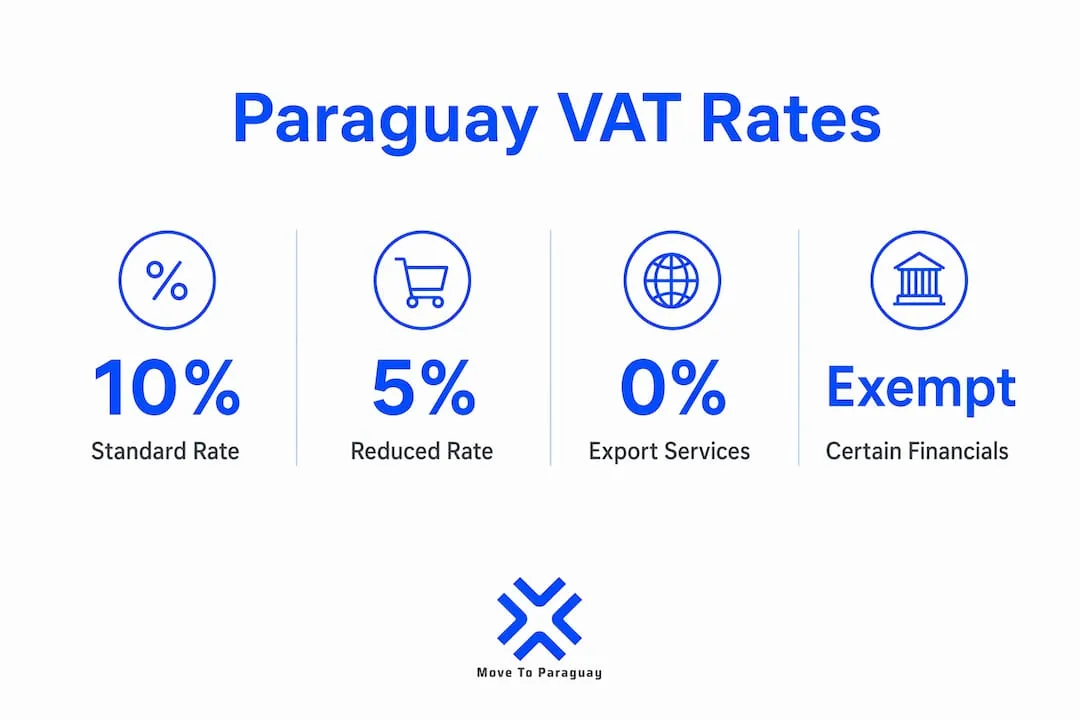 Infographic showing Paraguay VAT rates and categories
Each SIFEN invoice generates a document called a KuDE. The KuDE includes a QR code that serves as the only legally valid proof of purchase. The underlying file is an XML transmitted directly to DNIT in real time. That means DNIT sees every transaction as it happens, which makes SIFEN function as a live tax ledger.
Foreign companies without local VAT registration are not part of SIFEN. In those cases, local buyers handle self-invoicing or import documentation to satisfy VAT accounting requirements.
Steps to get SIFEN compliant:
- Register with DNIT and obtain your RUC (taxpayer identification number).
- Apply for a digital certificate from an authorized provider.
- Select homologated invoicing software approved by DNIT.
- Complete the homologation process by testing your software against DNIT's system.
- Activate your SIFEN account and begin issuing electronic invoices before your group's start date.
- Retain all XML invoice files and KuDE documents for at least 5 years.
Pro Tip: Check DNIT's official resolution list at least quarterly. Your taxpayer group assignment can change with little advance notice, and missing your activation date triggers penalties.
What are the VAT billing requirements for expat freelancers and foreign service providers?
Expat freelancers billing foreign clients can access the 0% VAT rate on export services if they meet three conditions: the service originates in Paraguay, the client is a foreign entity, and the transaction is backed by a formal contract and payment proof. Meeting all three conditions is what qualifies the invoice as an export, not just the fact that the client is overseas.
The risk of misclassification is real and costly. If you do not correctly classify a service invoice as an export, automatic 10% VAT applies even when the service is consumed entirely abroad. That is a direct hit to your margin on every invoice.
For services provided locally to Paraguayan clients, charging 10% VAT is mandatory. There is no option to waive it. If you provide consulting, design, or technical services to a local business, you collect 10% VAT and remit it to DNIT.
Non-resident digital service providers face additional requirements. Since 2022, non-residents must register with DNIT, appoint a local tax representative, and submit quarterly transaction reports. This rule captures SaaS platforms, subscription services, and any digital product sold into Paraguay without a local office.
Key billing and documentation practices to avoid audits:
- Keep signed contracts for every foreign client engagement, specifying the service origin as Paraguay.
- Retain proof of payment in foreign currency, such as wire transfer records or PayPal receipts.
- Issue all invoices through SIFEN once your group is activated, including export-classified invoices.
- File quarterly VAT returns on time, even in periods with zero taxable transactions.
- Store all supporting documents for a minimum of 5 years, as required by Paraguayan VAT recordkeeping rules.
- Consult a local tax professional before issuing your first invoice to confirm the correct VAT classification.
How can expats manage VAT efficiently and stay compliant in Paraguay?
Timely SIFEN compliance is the foundation of VAT management for expats. Once your activation date passes, every invoice must be electronic. Issuing a paper invoice after that date is legally invalid and creates a gap in your VAT records that DNIT can flag.
Documentation is your best defense in any audit. Keep contracts, payment records, and SIFEN XML files organized by tax period. The 5-year retention requirement means you need a reliable filing system from day one, not something you patch together later.
Hiring a local accountant or tax advisor who specializes in Paraguayan VAT rules pays for itself quickly. They track DNIT resolution updates, manage your quarterly filings, and catch classification errors before they become penalties. For expats running a Paraguayan company, integrating SIFEN-compatible accounting software with your existing ERP or bookkeeping tool reduces manual errors and speeds up filing.
Need personalized help?
Get expert guidance for your Paraguay relocation journey. Our team is here to help you with residency, business setup, real estate, and banking solutions.
Practical compliance tips for expats:
- Monitor DNIT's official resolution list for new mandatory e-invoicing group assignments.
- Use only DNIT-homologated software for invoice generation and transmission.
- Separate your export-service invoices from local-service invoices in your accounting records.
- Set calendar reminders for quarterly VAT return deadlines.
- Review your invoice VAT categories every six months as your business activities evolve.
| Taxpayer type | Filing frequency | Key deadline |
|---|
| Registered local business | Monthly | Last business day of following month |
| Non-resident digital provider | Quarterly | End of month following quarter |
| Export-only service provider | Quarterly | End of month following quarter |
Understanding the Paraguayan tax system for expats in full, not just VAT, helps you see how IVA fits into your overall tax position. Paraguay's territorial tax system means foreign-source income generally carries 0% income tax, which makes VAT compliance the primary ongoing obligation for most expats.
Key Takeaways
Paraguay's VAT system is manageable for expats who understand the three rates, meet SIFEN deadlines, and document every transaction correctly from the start.
| Point | Details |
|---|
| Standard VAT rate | Paraguay charges 10% VAT on most goods and services sold locally. |
| Reduced rate for housing | Residential rentals, home sales, and mortgage interest qualify for 5% VAT. |
| Export service exemption | Services billed to foreign clients with contracts and payment proof qualify for 0% VAT. |
| SIFEN is mandatory | All registered taxpayers must issue electronic invoices through SIFEN by their assigned group date. |
| Recordkeeping requirement | VAT records and SIFEN invoice files must be retained for at least 5 years. |
What I've learned watching expats get VAT wrong in Paraguay
Most expats I work with get the 10% rate right immediately. The problems show up in the details: a freelancer bills a U.S. client without a formal contract, assumes the 0% export rate applies, and then faces a 10% VAT assessment months later. The fix is simple, but the cost of not doing it upfront is real.
The SIFEN rollout catches people off guard more than any other issue. A small consulting business with two clients suddenly lands in a mandatory group and has two weeks to get homologated software, a digital certificate, and a compliant workflow in place. That is not impossible, but it is stressful and avoidable with six months of lead time.
What I find genuinely encouraging is that SIFEN, once set up, actually makes compliance easier. DNIT receives your invoice data in real time, which means your quarterly filing is mostly a confirmation of what the system already knows. The administrative burden drops significantly compared to manual paper-based systems.
My advice is direct: treat your DNIT registration and SIFEN setup as the first task after you establish residency, not an afterthought. The expats who do this early spend far less time and money on compliance than those who wait. And if you are billing foreign clients, get a signed contract in place before you issue your first invoice. That single document is what separates a 0% VAT invoice from a 10% one.
— Alejandro
How Movetoparaguay helps expats handle VAT and tax residency
Navigating Paraguay's VAT rules, SIFEN deadlines, and tax residency requirements is straightforward with the right support. Movetoparaguay provides tailored consultations that review your specific situation, whether you are a freelancer billing foreign clients, a remote worker establishing residency, or a business owner setting up a Paraguayan company.
Movetoparaguay's services cover DNIT registration, company formation, VAT compliance setup, and ongoing tax filing support. Every client receives a clear plan with specific next steps and transparent timelines. If you want professional guidance on tax residency and VAT compliance, Movetoparaguay is the place to start.
FAQ
What is Paraguay's VAT rate in 2026?
Paraguay applies a standard 10% VAT rate on most goods and services. A reduced 5% rate applies to residential rentals, home sales, and mortgage interest payments.
Do expat freelancers need to charge VAT on services to foreign clients?
Qualifying export services billed to foreign clients carry a 0% VAT rate, provided you have a formal contract and documented proof of payment. Without those documents, the standard 10% rate applies automatically.
What is SIFEN and when does it apply to expats?
SIFEN is Paraguay's mandatory electronic invoicing platform operated by DNIT. All registered taxpayers must use it by their assigned group activation date, with the rollout continuing through september 1, 2027.
How long must expats keep VAT records in Paraguay?
Paraguayan law requires VAT records, including SIFEN XML invoice files, to be retained for at least 5 years.
Do non-resident digital service providers face VAT obligations in Paraguay?
Yes. Non-resident digital service providers must register with DNIT, appoint a local tax representative, and file quarterly VAT reports, a requirement in place since 2022.