A local sponsor is not required to obtain residency in Paraguay. Under Law 6984/2022, the Dirección Nacional de Migraciones (DNM) grants residency through a direct administrative process, with no sponsoring individual or entity needed. The role of local sponsor residency Paraguay applicants once worried about is now largely a myth, kept alive by outdated blogs and advice written before the 2022 reforms. Movetoparaguay works with U.S. expats and entrepreneurs who arrive expecting a complicated sponsorship process, only to find that Paraguay's current system is far more accessible than they imagined.
What is a local sponsor and why do people think it's required?
A local sponsor, in traditional immigration contexts, is a person or registered entity that vouches for a foreign national and takes legal or financial responsibility for their stay. Many countries require this for visa or residency applications. Paraguay once had similar requirements tied to legacy visa categories, and that history is the root of today's confusion.
 Woman reviewing Paraguay residency documents at desk
The 2022 immigration reforms abolished the rentista and pensionado visa categories that carried deposit and sponsorship-like requirements. Those categories required applicants to demonstrate ongoing income through a local financial institution or have a local party vouch for them. Both requirements are gone.
Common sources of confusion include:
- Outdated online guides written before 2022 that still reference deposit or sponsorship requirements
- Conflating residency with work permits, which do require employer sponsorship from a registered entity
- Applying immigration logic from other countries where local sponsors are standard practice for residency
- Misleading service providers who imply a sponsor is needed to justify their fees
The distinction between residency sponsorship and work permit sponsorship is the most important one to understand. Most confusion arises from treating these two processes as the same. They are not. Residency is an administrative application. Work authorization is a separate employment-based process with its own rules.
Paraguay's current residency framework is an administrative procedure managed by the DNM. You do not need a sponsor, a minimum investment, or a local deposit. You need the right documents, the correct fees, and either a local presence or a professional representative to handle in-country steps.
The standard process follows these steps:
- Gather foreign documents. These include your passport, birth certificate, police clearance, and marriage certificate if applicable. Each document requires apostille certification and official translation into Spanish.
- Arrive in Paraguay. You must be physically present in the country to submit your application and provide biometrics.
- Obtain local declarations. The Certificado de Vida y Residencia (Certificate of Life and Residence) requires sworn statements from Paraguayan nationals confirming your presence. This is a local procedural step, not sponsorship.
- Submit your application to the DNM. Fees run approximately Gs. 2,787,550 plus Gs. 223,004 for related processing, which translates to roughly $460–$490 USD at current exchange rates.
- Receive your temporary residency. Temporary residency is valid for up to 2 years and is renewable. It comes with a cédula (national ID) and a tax ID, enabling you to live, work, and set up a business legally.
- Apply for permanent residency. After holding temporary residency, you can apply for permanent status through the same administrative channel.
Pro Tip: Engaging a local immigration professional to handle the sworn declarations and document submissions can reduce your required time in Paraguay from several weeks to just a few days.
No investment minimum applies to the standard administrative route. If you prefer a faster path to permanent residency, Paraguay's Investor Pass program grants direct permanent residency through qualifying investments ranging from $70,000 to $200,000 across multiple sectors, with no local sponsor required there either.
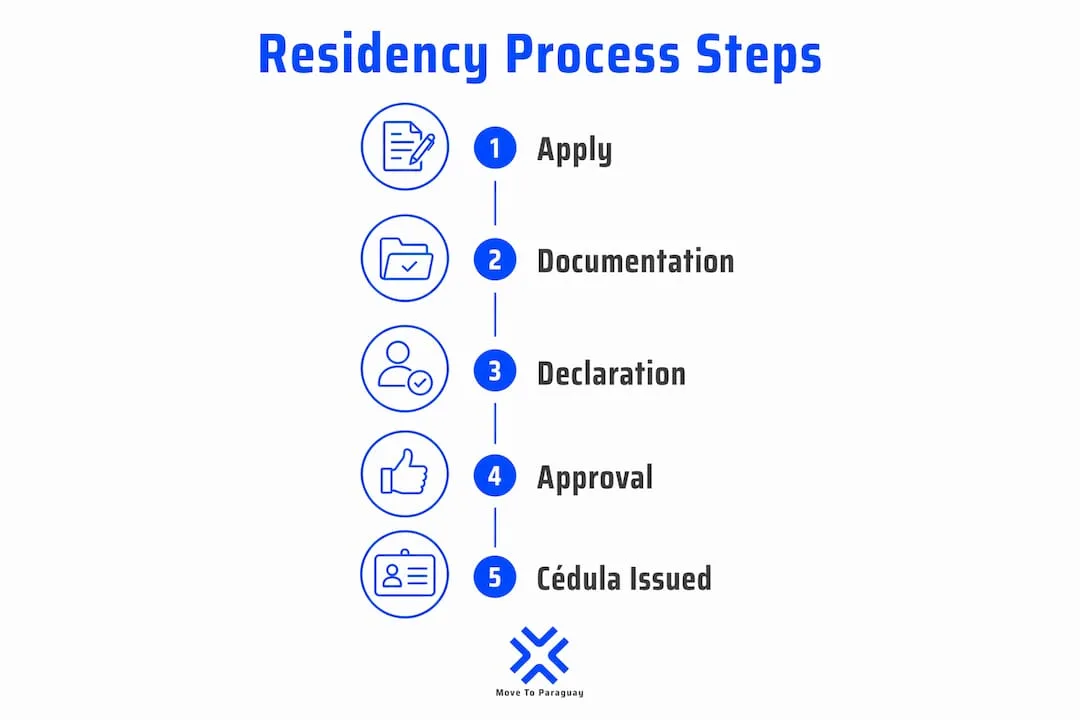 Infographic outlining Paraguay residency steps
Sponsorship does apply in Paraguay, but only for employment-based work permits. This is the category that trips up expats who plan to work for a Paraguayan employer or bring foreign employees into the country.
For a work permit, the sponsoring employer must meet specific legal requirements:
- Registered legal entity in Paraguay with active commercial registration
- Tax compliance with the Subsecretaría de Estado de Tributación (SET), Paraguay's tax authority
- Social security registration with the Instituto de Previsión Social (IPS)
- Signed employment contract with the foreign worker, compliant with Paraguay's Labor Code
The employer's IPS contribution is typically 16.5% of gross salary, with the employee contributing 9%. Employer of Record (EOR) providers legally employ foreign workers on behalf of client companies, handling contracts, payroll, IPS registration, and work permit processing. EOR services act as the sponsoring employer, not as a residency sponsor. Work permit processing through an EOR typically takes 3–4 weeks.
Pro Tip: If you plan to work remotely for a foreign company while living in Paraguay, you do not need a work permit or an employer sponsor. Paraguay's territorial tax system means your foreign-source income is generally taxed at 0%, and your residency application is entirely separate from your work arrangements.
The key takeaway is this: if you are a remote worker, freelancer, or entrepreneur relocating to Paraguay, employer sponsorship is not part of your residency process at all. It only becomes relevant if you seek local employment or hire staff through a Paraguayan entity.
How can expats and entrepreneurs navigate residency without a local sponsor?
The biggest practical risk for applicants today is acting on outdated information. The 2022 reforms simplified the entire residency framework, but old content still ranks highly in search results and leads applicants to prepare for requirements that no longer exist.
Here is what actually helps:
- Verify your sources. Check that any guide or service you consult references Law 6984/2022 explicitly. If it mentions deposit requirements or a local sponsor for residency, it predates the reforms.
- Prepare your foreign documents early. Apostille certification and certified Spanish translation take time. Starting this process before you book your flight saves weeks.
- Hire a local representative for declarations. The Certificado de Vida y Residencia requires Paraguayan nationals to provide sworn statements. A local professional handles this without you needing to know anyone personally.
- Avoid services that claim to provide a "sponsor." No legitimate residency process in Paraguay requires a paid sponsor. Any service framing it that way is either misinformed or misleading.
- Know your residency options. The standard administrative route suits most expats. The Investor Pass suits those with capital who want permanent residency immediately. Both routes are sponsor-free.
Need personalized help?
Get expert guidance for your Paraguay relocation journey. Our team is here to help you with residency, business setup, real estate, and banking solutions.
Understanding temporary vs. permanent residency distinctions also matters. Temporary residency is the entry point for most applicants. Permanent residency follows after meeting the time and renewal requirements. Neither stage involves a local sponsor.
Key Takeaways
Paraguay's residency process under Law 6984/2022 requires no local sponsor, no deposit, and no minimum investment for the standard administrative route.
| Point | Details |
|---|
| No sponsor required for residency | Law 6984/2022 made residency a direct administrative process with the DNM. |
| Sponsorship applies only to work permits | Employer sponsors are required for work authorization, not for residency applications. |
| Local declarations are not sponsorship | The Certificado de Vida y Residencia involves sworn statements, not a legal sponsor relationship. |
| Outdated info is the main risk | Guides written before 2022 still reference deposit and sponsorship rules that no longer exist. |
| Investor Pass offers a direct permanent residency route | Qualifying investments from $70,000 to $200,000 grant permanent residency without a sponsor. |
Why the sponsor myth persists, and what I've actually seen on the ground
From my experience working with expats relocating to Paraguay, the local sponsor myth is one of the most persistent and damaging pieces of misinformation in this space. I have spoken with applicants who delayed their move by six months because they were trying to "find a sponsor" they did not need. Others paid inflated fees to services that implied a sponsor was part of the process.
The confusion is understandable. Many countries do require local sponsors for residency, and people naturally apply that framework to Paraguay. The 2022 reforms were significant, but they did not generate the same volume of online coverage as the old system did over many years. So the old content still dominates search results, and applicants find it first.
What I tell every client is this: Paraguay's residency system rewards preparation, not connections. You do not need to know anyone locally. You need the right documents, correctly apostilled and translated, and someone on the ground who knows the DNM process. That is a professional service, not a sponsor.
The distinction between residency and work authorization is equally misunderstood. Remote workers and entrepreneurs almost never need employer sponsorship. They need residency, and that is a clean administrative process. Conflating the two creates unnecessary anxiety and unnecessary expense.
My honest recommendation is to use official sources and professionals who specialize in current Paraguayan immigration law. The process is genuinely straightforward when you have accurate information.
— Alejandro
How Movetoparaguay supports your residency application
Movetoparaguay works with U.S. expats and remote workers who want a clear, accurate path through Paraguay's residency process without the confusion of outdated sponsorship myths.
The team at Movetoparaguay handles the full administrative process, from document preparation and apostille guidance to local declarations and DNM submissions. Every consultation reviews your individual case in detail, so you receive specific next steps rather than generic advice. Paraguay's territorial tax system generally means 0% tax on foreign-source income, and Movetoparaguay also supports company formation and ongoing tax compliance for those building a business here. Visit Movetoparaguay to book a consultation and get a clear picture of your residency timeline and costs.
FAQ
Is a local sponsor required for Paraguay residency?
No. Paraguay residency under Law 6984/2022 is a direct administrative process managed by the DNM, with no local sponsor, deposit, or investment minimum required.
What is the difference between residency sponsorship and work permit sponsorship in Paraguay?
Residency requires no sponsor. Work permits require an employer sponsor that is a registered, tax-compliant Paraguayan entity. The two processes are entirely separate.
How long does Paraguay temporary residency last?
Temporary residency is valid for up to 2 years and is renewable. It comes with a cédula and tax ID, and it serves as the pathway to permanent residency.
What is the Certificado de Vida y Residencia, and does it require a sponsor?
The Certificado de Vida y Residencia is a sworn declaration by Paraguayan nationals confirming your physical presence in the country. It is a procedural document, not a sponsorship arrangement, and a local professional can obtain it on your behalf.
Can remote workers relocate to Paraguay without employer sponsorship?
Yes. Remote workers employed by foreign companies do not need a Paraguayan work permit or employer sponsor. Their residency application is a separate administrative process, and their foreign-source income is generally subject to 0% tax under Paraguay's territorial tax system.