Why Territorial Tax Benefits Expats: 2026 Guide
Territorial taxation is defined as a system that taxes residents only on income earned within the country's borders, leaving all foreign-sourced income completely untaxed locally. This is the core reason why territorial tax benefits expats so significantly. The IRS still taxes U.S. citizens on worldwide income regardless of where they live, but a territorial host country like Paraguay adds zero local tax on top of that foreign income. Tools like the Foreign Earned Income Exclusion (FEIE) and Foreign Tax Credits help manage U.S. obligations, but the host country's territorial system is what creates real savings on the ground.
How do territorial tax systems work for U.S. expats?
Territorial tax systems tax only income earned within their borders, treating foreign-sourced income as 0% taxable locally. That single rule is what separates territorial countries from worldwide tax regimes. Under a worldwide system, every dollar you earn anywhere on earth is potentially taxable. Under a territorial system, only the dollars you earn inside that country count.
 Man reviewing tax residency documents at home desk
For U.S. expats, this creates a two-layer picture. The IRS continues to tax your global income no matter where you live. The host country, however, only taxes what you earn locally. If you earn your income from clients or employers outside the territorial country, your local tax bill is zero.
The mechanics work like this:
- Income source determines taxability. Income earned from within the territorial country is taxed locally. Income from foreign clients, foreign investments, or foreign employers is exempt from local tax.
- Residency triggers reporting. Spending more than 183 days in most countries establishes tax residency, requiring you to file local returns even when your foreign income owes zero tax.
- FEIE and Foreign Tax Credits apply on the U.S. side. These IRS mechanisms reduce your American tax bill on foreign-earned income, but they do not eliminate your U.S. filing obligation.
- Popular territorial countries include Paraguay, Panama, and Costa Rica. Each has different residency income thresholds and reporting rules.
Paraguay stands out because it has one of the lowest income thresholds among territorial tax countries, with a minimum verified monthly income requirement of approximately $1,300 for temporary residency. Panama and Costa Rica set their thresholds higher. That affordability makes Paraguay a practical first choice for budget-conscious expats.
Pro Tip: Establishing tax residency and obtaining an immigration visa are two separate legal events. Holding a visa does not make you a tax resident. Your physical presence and local registration determine your tax status.
What are the specific benefits of territorial tax residency?
The benefits of territorial tax residency go well beyond a lower tax rate. The system creates predictability, which is something most expats undervalue until they have lived under a complex worldwide tax regime.
Here are the core advantages:
- Zero local tax on foreign income. If you earn from clients outside the country, that income is not taxed locally at all. This applies to freelancers, remote employees, and business owners with foreign-based revenue.
- Predictable long-term planning. Territorial systems enable stable wealth planning by excluding foreign income from local taxation, which supports capital reinvestment and intergenerational wealth preservation.
- Simplified compliance. Under a worldwide tax system, you track foreign tax credits, report global assets, and reconcile multiple tax treaties. A territorial system removes the local layer of that complexity entirely.
- Lower cost of living compounds the savings. Countries like Paraguay offer a significantly lower cost of living compared to the U.S. The tax savings and reduced living costs together create a compounding financial benefit.
- Advantages for business owners. If you own a company that earns revenue from foreign clients, a territorial jurisdiction means that company's foreign income faces no local corporate tax. Tax neutrality attracts investors by reducing the complexity of worldwide tax credits and enabling efficient global portfolio management.
Remote workers and digital nomads benefit most directly. Your clients are abroad, your income is foreign-sourced, and the territorial country taxes none of it locally. That is the cleanest version of the benefit.
Pro Tip: If you hold offshore investments or receive dividends from foreign accounts, confirm with a local tax advisor whether those qualify as foreign-sourced income in your specific territorial jurisdiction. The classification rules vary by country.
What pitfalls do expats face with territorial tax systems?
Territorial tax systems are not automatic tax shelters. Several common mistakes can eliminate the benefits entirely or create unexpected liability.
-
Misclassifying income as foreign-sourced. If you physically perform work inside the territorial country for foreign clients, local tax authorities may classify that income as locally sourced. Documentation proving work was done outside the country is critical to defend against reclassification.
-
Confusing a visa with tax residency. A digital nomad visa is an immigration document. It does not grant tax residency or territorial tax benefits. Digital nomad visas do not confer tax residency; spending over 183 days triggers tax resident status separately.
-
Ignoring U.S. filing obligations. U.S. citizens remain subject to IRS worldwide income tax regardless of territorial residency abroad. Territorial benefits reduce your host country tax bill, not your U.S. filing requirement. You still file a U.S. return every year.
-
Improper business structuring. Setting up a local company but routing foreign income through it incorrectly can create a taxable nexus inside the country. That turns foreign income into local income, eliminating the territorial benefit.
-
Weak documentation. Working remotely for foreign clients with physical presence inside the territorial country risks local source income classification. Clear client contracts, work location evidence, and timestamped records are your best defense.
Understanding expatriate tax obligations before you relocate prevents the most costly mistakes. The rules are manageable, but they require deliberate attention from day one.
How do you establish and maintain territorial tax residency?
Establishing territorial tax residency requires meeting specific legal thresholds in your chosen country. The process is not complicated, but it must be done correctly to secure the benefits.
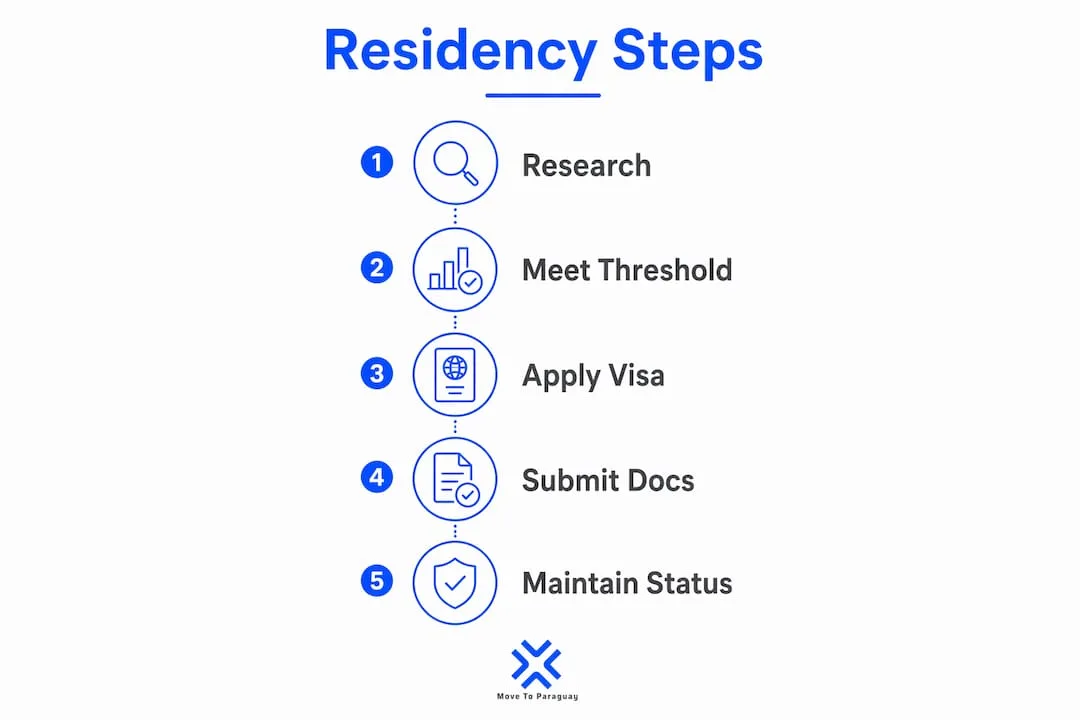 Infographic showing steps to establish tax residency
The table below compares three of the most popular territorial tax countries for U.S. expats:
| Country | Minimum Monthly Income | Residency Process | Local Tax on Foreign Income |
|---|
| Paraguay | ~$1,300 | Straightforward, low threshold | 0% |
| Panama | ~$2,000 | Moderate documentation | 0% |
| Costa Rica | ~$3,000 | More documentation required | 0% |
Need personalized help?
Get expert guidance for your Paraguay relocation journey. Our team is here to help you with residency, business setup, real estate, and banking solutions.
Paraguay has one of the easiest residency processes among territorial tax countries, which is why it attracts budget-conscious expats and first-time relocators. The income threshold is the lowest of the three, and the documentation requirements are manageable with proper guidance.
To maintain your territorial tax residency correctly, follow these steps:
- Register with the local tax authority and obtain your tax identification number. In Paraguay, this is the RUC (Registro Único del Contribuyente). Movetoparaguay provides a full RUC registration guide for expats.
- File local tax returns annually, even when your foreign income owes zero local tax. Filing confirms your residency status and keeps you compliant.
- Maintain records of where your work is physically performed. Contracts, invoices, and email trails all support your foreign-source income classification.
- Coordinate your U.S. filings with your local filings. Use the FEIE to exclude qualifying foreign-earned income from U.S. taxable income, and use Foreign Tax Credits for any local taxes you do pay.
- Consult a tax professional who understands both the host country's territorial rules and IRS requirements. U.S. expats must integrate territorial benefits with IRS rules to maximize exclusions without risking double taxation or penalties.
Understanding the difference between temporary and permanent residency rights in Paraguay also matters for long-term planning. Temporary residency is the entry point; permanent residency opens additional legal and financial options.
Key Takeaways
Territorial tax systems benefit expats because they tax only locally earned income, leaving foreign-sourced income at 0% locally while U.S. obligations are managed through FEIE and Foreign Tax Credits.
| Point | Details |
|---|
| Territorial tax definition | Only income earned inside the country is taxed locally; foreign income owes 0% local tax. |
| U.S. obligations remain | The IRS taxes worldwide income regardless of where you live; FEIE and Foreign Tax Credits reduce but do not eliminate U.S. filing. |
| Paraguay's low threshold | Paraguay requires approximately $1,300 monthly income for temporary residency, the lowest among top territorial countries. |
| Documentation is critical | Proof of where work is physically performed determines whether income is classified as foreign-sourced or locally taxable. |
| Visa is not tax residency | An immigration visa does not grant territorial tax benefits; the 183-day rule and local registration establish tax residency. |
Why territorial tax planning rewards the careful expat
I have seen expats arrive in Paraguay convinced that simply getting a residency visa means their tax problems are solved. That assumption is the most expensive mistake in this space. The territorial system is genuinely powerful, but it rewards people who treat it as a legal structure to maintain, not a loophole to exploit.
What I find most underappreciated is the documentation requirement. Most expats focus on the income threshold and the residency process, then forget to build a paper trail proving where their work actually happens. A single year of weak records can give a local tax authority grounds to reclassify foreign income as local income. That reclassification wipes out the benefit retroactively.
The other thing I want to be direct about: the territorial system does not replace your U.S. tax obligations. It sits alongside them. The expats who do this well use the FEIE and Foreign Tax Credits on the U.S. side while keeping their host country filings clean and current. That dual-track approach requires a tax professional who understands both systems. Trying to manage it alone, especially in the first year, is a false economy.
Paraguay remains one of the most accessible entry points into territorial tax residency for Americans. The income threshold is low, the process is clear, and the legal framework is stable. But "accessible" does not mean "automatic." Treat it with the same seriousness you would give any legal tax structure, and it will serve you well for years.
— Alejandro
How Movetoparaguay helps U.S. expats secure territorial tax residency
Paraguay is one of the most accessible territorial tax countries for U.S. expats, with a 0% local tax rate on foreign-sourced income and a residency income threshold of approximately $1,300 per month.
Movetoparaguay specializes in guiding U.S. expats through every step of the residency and tax compliance process in Paraguay. From your initial case review to company formation and ongoing tax filings, the team provides clear timelines, transparent fees, and specific next steps tailored to your situation. If you are ready to understand exactly how territorial tax residency applies to your income and circumstances, explore your options with Movetoparaguay and get a structured path forward.
FAQ
What is a territorial tax system?
A territorial tax system taxes residents only on income earned within the country's borders. Foreign-sourced income is treated as 0% taxable locally, making it a major advantage for expats with overseas clients or investments.
Does moving to a territorial tax country eliminate my U.S. tax obligations?
No. U.S. citizens remain subject to IRS worldwide income tax regardless of where they live. Territorial residency reduces your host country tax bill, but you still file a U.S. return and use tools like the FEIE or Foreign Tax Credits to manage your American obligations.
How does the 183-day rule affect expats in territorial countries?
Spending more than 183 days in a country typically establishes tax residency, requiring you to file local returns even when your foreign income owes zero local tax. Crossing that threshold without registering properly creates compliance risk.
Is Paraguay a good choice for territorial tax residency?
Paraguay has one of the lowest residency income thresholds among territorial tax countries, at approximately $1,300 per month, and a straightforward residency process. Those factors make it a practical option for budget-conscious U.S. expats seeking territorial tax advantages.
Can I lose my territorial tax benefits if I work inside the country?
Yes. If you physically perform work inside a territorial country for foreign clients, local authorities may classify that income as locally sourced. Clear contracts, work location records, and professional guidance protect your foreign-source income classification.